









In Shunyi Park, northeast of Beijing, summer evenings have taken on the atmosphere of a World Cup festival. Under the floodlights of a synthetic football pitch, teenagers exchange passes while groups of supporters discuss the previous day’s results. Amid the conversations, one name keeps coming up with surprising frequency: Morocco.
More than 10,000 kilometers from Rabat, the Atlas Lions have emerged as one of the most closely followed teams among Chinese football enthusiasts during the 2026 FIFA World Cup in North America.
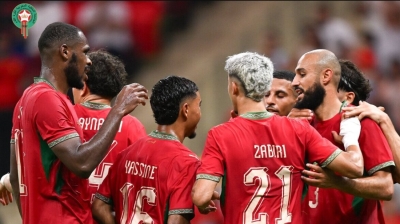
With four points from their first two matches—a prestigious 1–1 draw against Brazil followed by a controlled 1–0 victory over Scotland—Morocco has already secured qualification for the knockout stage. The achievement has revived the enthusiasm sparked by the team’s historic 2022 campaign and strengthened the belief among many Chinese fans that Morocco now belongs among the world’s football elite.
“I watched both matches from start to finish,” said Wen Zi, a 17-year-old high school student and amateur footballer. “Against Brazil, they proved they can compete with the biggest football nations. Against Scotland, they controlled the game in a match where mistakes were not allowed. You can feel that this is a team that has matured.”
Across Chinese social media platforms such as Douyin, Weibo, and Xiaohongshu, clips of Morocco’s matches are being widely shared. Analyses, commentaries, and videos dedicated to the Atlas Lions continue to multiply as the tournament progresses. Supporters praise the team’s tactical discipline, defensive solidity, and ability to stand up to opponents traditionally considered stronger.
An Admiration That Predates the North American World Cup
For many Chinese supporters, however, Morocco’s appeal goes beyond results.
“It’s their collective spirit,” explained Lu Yang, a 35-year-old employee at a Beijing technology company. “Today, many teams depend on a few star players. Morocco gives the impression that every player works for the group. That is a quality Chinese fans greatly appreciate.”
This admiration did not begin with the current tournament. Many Chinese football followers trace it back to the 2018 World Cup in Russia. Despite an early elimination, Morocco left a lasting impression through the quality of its football and its commitment on the field. Chinese sports commentator Xu Yang famously described the team with a phrase that has since become iconic:
“Moroccan football is pure.”
Eight years later, the expression is still frequently quoted on football forums and among supporters. For many, it perfectly captures a team whose identity is built on intensity, generosity, and determination.
The Lasting Impact of the 2022 World Cup
Morocco’s historic run to the semi-finals of the 2022 World Cup—the first by an African and Arab nation—left a deep mark on the Chinese sporting imagination. Victories over Belgium, Canada, Spain, and Portugal generated widespread admiration in a country whose own national team has largely been absent from the global stage.
What attracts Chinese supporters today is no longer merely the memory of that remarkable campaign. It is Morocco’s ability to confirm, tournament after tournament, that its success was no coincidence and that it belongs among the world’s top football nations.
When Team Spirit Becomes an Inspiration
For many Chinese football fans, the Atlas Lions represent more than a sporting success story.
Supporters frequently highlight the solidarity displayed by the players, their collective commitment, and their willingness to sacrifice for one another. These qualities resonate strongly in a society where teamwork and collective responsibility remain deeply valued.
Another aspect that fascinates many observers is the background of several Moroccan internationals, who were born or raised in Europe but chose to represent Morocco.
“This loyalty impresses a lot of people in China,” said Wen Zi. “They could have chosen different paths, but they decided to represent Morocco. It shows a deep attachment to their roots.”
For many Chinese observers, this reflects values that go beyond football—loyalty, belonging, and responsibility toward one’s community.
Images of Moroccan players celebrating victories with their mothers during the Qatar World Cup also continue to circulate on Chinese social media. Many see in those moments the expression of universal values: respect for parents, humility in victory, and devotion to family.
A Story Still Being Written
As Morocco continues its World Cup journey in North America, many believe the team is proving that its achievements in 2022 were not a one-off miracle.
“In 2022, some people called it a surprise,” Lu Yang said with a smile. “Today, Morocco is showing that it has become a great team.”
In a country where football remains immensely popular despite the struggles of the national team, the Atlas Lions have achieved something rare: they have transformed admiration born from a remarkable feat into lasting affection and respect.
As night falls over Shunyi Park and the last players leave the pitch, the discussions continue. Thousands of kilometers away, Morocco is preparing for its next World Cup challenge. And in Beijing, countless supporters will once again be watching, convinced that the story of Moroccan football still has many glorious chapters left to write.