








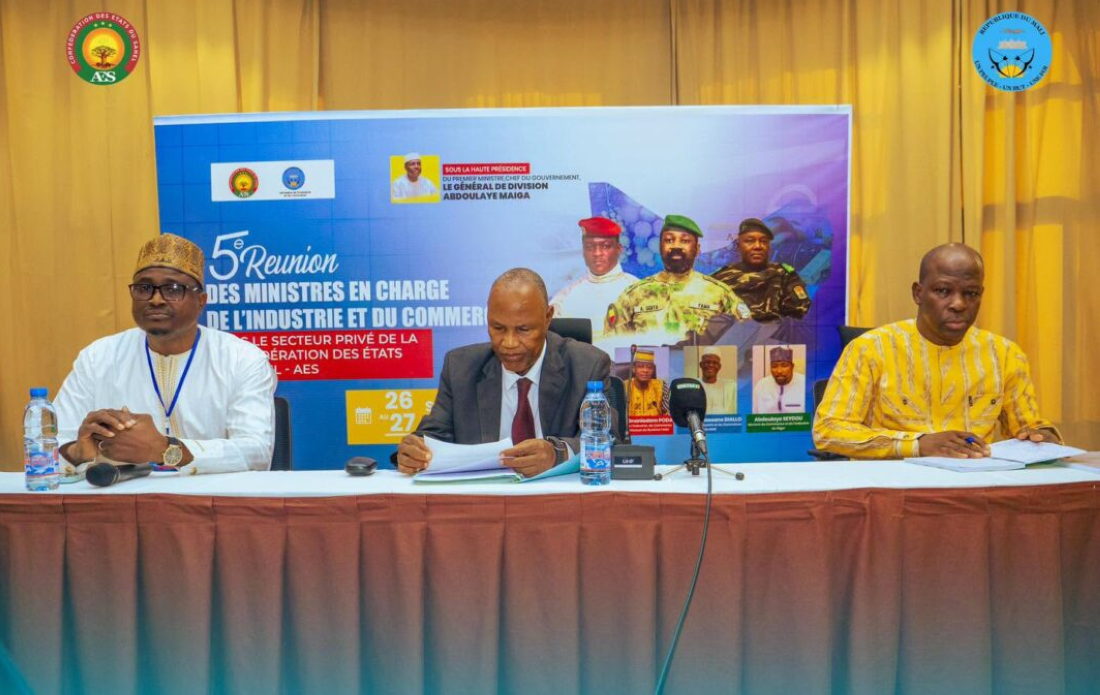


The Confederation of Sahel States (AES) has stepped up efforts toward deeper economic integration, with experts from Mali, Burkina Faso and Niger meeting in Bamako to address barriers to trade and prepare the bloc’s next ministerial meeting on industry and commerce.
The two-day technical session, launched on Saturday, September 26, is reviewing implementation of the Priority Action Plan and identifying obstacles to the free movement of people and goods across the confederation.
Discussions are also focusing on financing strategic sectors and measures to boost trade among the three countries.
Key Projects Under Review
Experts are assessing several initiatives agreed at previous ministerial meetings, including the creation of a joint purchasing agency for essential goods, a Business Climate Observatory and the harmonization of investment rules.
Private-sector representatives will also take part in a dedicated session to highlight challenges facing businesses in trade, industrialization and investment across the AES.
A Market of 75 Million People
The economic stakes are significant. Mali, Burkina Faso and Niger had a combined population of around 75.1 million in 2024 and a total GDP of nearly $69.8 billion, according to World Bank data.
Together, the three countries cover almost 2.8 million square kilometers, providing considerable potential for expanding trade and investment.
All three countries use the CFA franc and are members of the West African Economic and Monetary Union (WAEMU), whose framework provides for the free movement of people, goods, services and capital.
The Bamako talks are therefore expected to examine how the AES’s planned trade mechanisms will interact with existing WAEMU arrangements.
Harmonizing Economic Rules
The AES economic integration process began with a first ministerial meeting in Bamako in October 2024. A second meeting in April 2025 led to the establishment of a tripartite committee tasked with monitoring implementation of recommendations.
In June 2026, ministers adopted an updated Priority Action Plan, terms of reference for a directive aimed at improving investment attractiveness, and measures to combat fraud and unfair competition.
They also agreed in principle to establish a common framework for product certification, standardization and quality control.
Financing and Timeline in Focus
The upcoming ministerial meeting is expected to focus on implementation timelines, project financing and the operating arrangements for the proposed joint purchasing agency.
Recommendations from the Bamako technical talks will form the basis of the AES’s next roadmap for trade, industry and investment.
The broader objective is to turn the three countries’ economic integration ambitions into concrete mechanisms that facilitate trade and strengthen industrial and commercial activity across the confederation.