








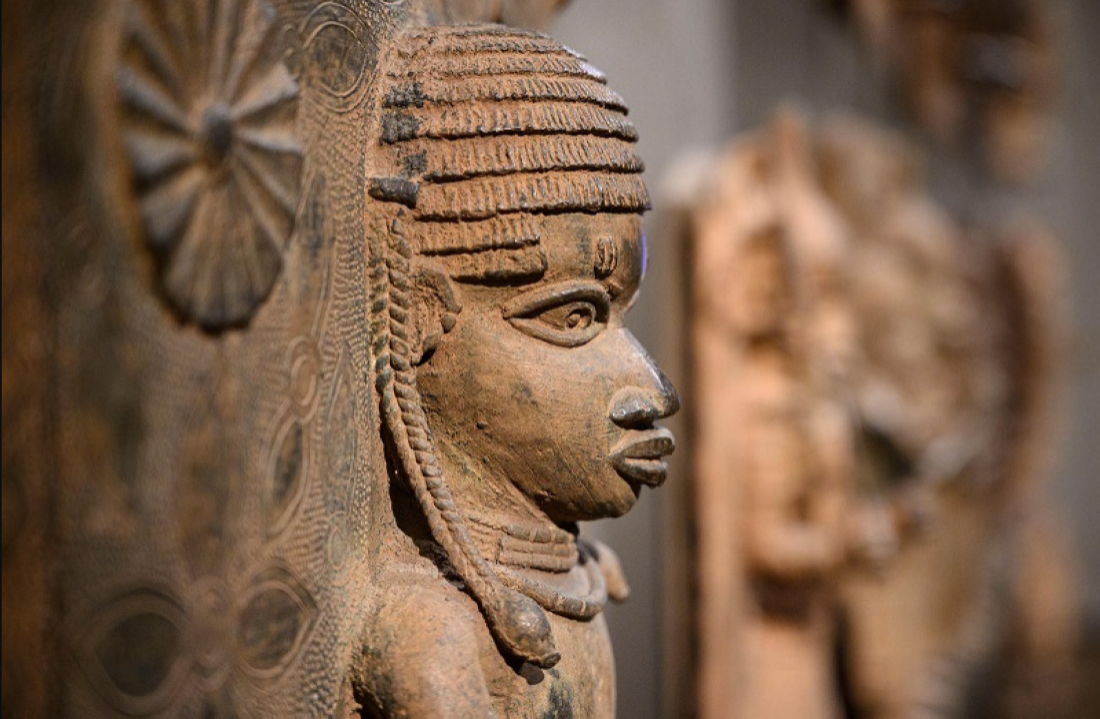


The University of Cambridge has announced the restitution of 116 artifacts from the Kingdom of Benin to Nigeria, marking a new milestone in the process of returning African works held in Europe.
This restitution follows an official request made by Nigeria in 2022 and represents, according to Olugbile Holloway, Director-General of the Nigerian National Commission for Museums and Monuments, a “restoration of the pride and dignity lost when they were taken.”
The 116 treasures, commonly known as the “Benin Bronzes,” were seized by British forces in 1897. Nearly 129 years later, they will return to the museum and the Royal Palace of the Oba in Benin City, capital of Edo State. The artifacts, made of bronze, ivory, and wood, will partly be retained for research and educational purposes: 17 objects will remain on loan, while the Cambridge Museum of Anthropology will continue to hold approximately 400 additional pieces from the Kingdom of Benin, according to TV5MONDE.
Over the past decade, Europe has embarked on a movement to return looted African treasures, ranging from symbolic gestures to large-scale restitutions, in a broader effort toward historical justice and cultural reappropriation. This movement gained decisive momentum with the publication of the 2018 Sarr-Savoy report, titled “Report on the Restitution of African Cultural Heritage: Toward a New Relational Ethics.”
Written by Senegalese economist Felwine Sarr and French art historian Bénédicte Savoy, the report recommended the large-scale restitution of African works held in European museums, particularly those acquired illegitimately during the colonial period.
Since then, several countries have carried out restitutions. In November 2021, 26 royal treasures from Abomey, looted in 1892 by France, were returned to the Republic of Benin. In 2022, Germany committed to returning more than 500 Benin Bronzes following an official visit to Nigeria, while 168 objects will remain on long-term loan in Berlin, as stated by Hermann Parzinger, President of the Prussian Cultural Heritage Foundation. Belgium, the Netherlands, and Austria have also announced large-scale returns of artworks, including an inventory of 84,000 objects from the Tervuren Museum near Brussels intended for the Democratic Republic of Congo, and more than one hundred Benin bronzes held at the Wereldmuseum in Leiden, the Netherlands.
However, the return of African treasures presents a major challenge for recipient countries: ensuring proper preservation and conservation requires adequate infrastructure and significant funding, which can be difficult to mobilize. In this context, the cultural and economic valorization of these works can become a lever for development, provided it is embedded within a sustainable strategy.
Nigeria and Benin are often cited as models in Africa for their management of restitutions. The Museum of the Epic of the Amazons and Kings of Danxomè (MURAD), scheduled to open in 2027 in Abomey, illustrates this proactive approach to preserving and promoting cultural heritage.