







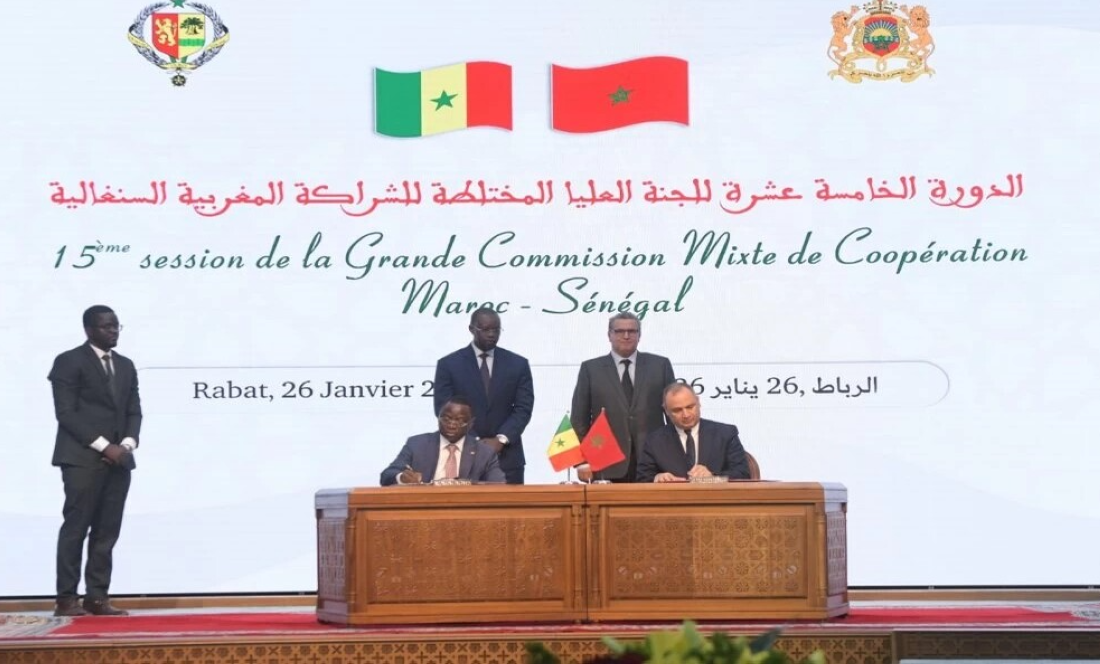


Rabat hosted on Monday, January 26, the 15th session of the High Joint Commission for Cooperation. The session concluded with the signing of several cooperation and partnership agreements, memoranda of understanding, and protocols aimed at elevating Morocco–Senegal relations to a new strategic level.
Meeting in Rabat, Morocco and Senegal agreed on Monday to significantly strengthen their bilateral cooperation at the end of the 15th session of the High Joint Commission for Cooperation, held under the chairmanship of the Heads of Government of both countries, Aziz Akhannouch and Ousmane Sonko.
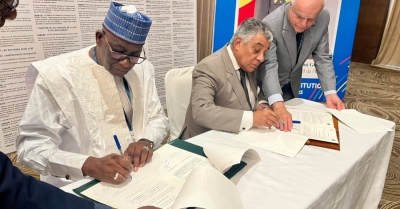
Several cooperation and partnership agreements, memoranda of understanding, and protocols were signed by the two countries on the occasion of this bilateral meeting.
Accordingly, the Minister of Foreign Affairs, African Cooperation and Moroccan Expatriates, Nasser Bourita, and the Minister of African Integration, Foreign Affairs and Senegalese Abroad, Cheikh Niang, signed the Joint Communiqué concluding the work of this 15th session of the Morocco–Senegal High Joint Commission for Cooperation.
The two ministers also signed a memorandum of understanding on the establishment of a mechanism for consular consultations, a draft memorandum of understanding in the field of youth, an implementation protocol for the agreement on international road transport of passengers and goods, a cooperation agreement in the field of road safety, and a framework agreement on technical assistance in the field of highways.
A protocol of agreement on cooperation in the digital economy was also signed by Mr. Bourita and Mr. Niang, in addition to a memorandum of understanding in the field of infrastructure, a framework cooperation agreement in vocational training, and a framework agreement relating to scholarships, internships, and the sharing of expertise.
In the field of higher education, the Minister of Higher Education, Scientific Research and Innovation, Azzedine El Midaoui, and his Senegalese counterpart, Daouda Ngom, signed the implementation program in higher education for the 2026–2028 period.
For their part, the Minister of Industry and Trade, Ryad Mezzour, and the Senegalese Minister of Industry and Trade, Serigne Gueye Diop, signed a memorandum of understanding on the development of small and medium-sized enterprises, a cooperation agreement in the field of industrial infrastructure, and a protocol of agreement on standardization.
Meanwhile, the Minister of Agriculture, Maritime Fisheries, Rural Development and Water and Forests, Ahmed El Bouari, and the Senegalese Minister of Agriculture, Food Sovereignty and Livestock, Mabouba Diagne, signed a cooperation agreement in the agricultural sector, as well as a cooperation agreement in the fields of animal production chains, animal health, and food safety.
El Bouari also signed, with the Senegalese Minister of Economy, Planning and Cooperation, Abdourahmane Sarr, a cooperation agreement in the field of sanitary control of fisheries and aquaculture products.
In the port sector, a partnership and cooperation agreement between the National Ports Agency (ANP) and the Autonomous Port of Dakar (PAD) was signed by the Director General of ANP, Mustapha Fares, and the Director General of PAD, Waly Diouf Bodian.
Likewise, the minutes of the work of this 15th Morocco–Senegal High Joint Commission for Cooperation were signed by Head of Government Aziz Akhannouch and Senegalese Prime Minister Ousmane Sonko.
During this session, the Moroccan Head of Government, Aziz Akhannouch, and his Senegalese counterpart, Ousmane Sonko, recalled the deep historical, human, and spiritual ties between Morocco and Senegal. The two officials reaffirmed their shared commitment to raising this partnership to a higher level, in line with the guidance of King Mohammed VI and Senegalese President Bassirou Diomaye Faye.
In his speech, Aziz Akhannouch emphasized the central importance of Morocco’s national cause, recalling the Moroccan autonomy initiative under the Kingdom’s sovereignty, as well as the major structuring projects launched by Rabat toward the Sahel and Africa’s Atlantic coastline. He highlighted the convergence of views between the two countries on regional, economic, and security issues.
Senegal reaffirms its constant commitment to working tirelessly to strengthen and expand cooperation with Morocco, in the spirit of the cultural, spiritual, and historical ties uniting the two peoples and in the higher interest of both countries, Sonko said.
Relations between the two nations are notably built on long-standing human, spiritual, economic, and cultural ties, as well as on political trust developed over time, Mr. Sonko stated.
Stressing that the very dynamic economic and trade cooperation between the two countries could be further strengthened, the official noted that this meeting aims to place the friendship linking Morocco and Senegal at the heart of public policies, revitalize the bilateral partnership, and enable both governments to establish a clear roadmap.
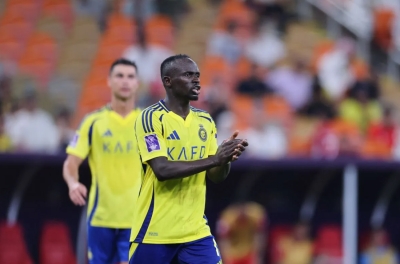
Referring indirectly to tensions that occurred following the AFCON 2025 final, he considered that the incidents observed were “emotional excesses linked to sporting enthusiasm,” calling on them not to be interpreted as political or cultural fractures.
On the sidelines of this session, the Senegalese Prime Minister visited the OCP industrial complex in Benguérir. A meeting between Moroccan and Senegalese economic operators is also scheduled in Casablanca to explore investment and partnership opportunities in both countries. Beyond the signatures, Rabat and Dakar thus intend to transform a historic relationship into a strategic lever for sustainable cooperation.