










Africa today stands at a strategic crossroads. It is a continent of immense natural wealth, demographic dynamism, and geopolitical potential—but also one increasingly targeted by external powers and transnational movements that thrive on weak states, ideological radicalism, and prolonged conflict. From the Sahel to the Horn of Africa, militant groups inspired by radical Islamist doctrines are expanding their reach, often nourished by political Islamist networks linked to the Muslim Brotherhood and enabled by Iranian influence. In this context, Sudan’s war is not an isolated national tragedy. It is a frontline battle for Africa’s future. If Sudan’s crisis is not resolved at its roots, the consequences will not stop at its borders. They will reverberate across Africa—and inevitably spill into Europe.
By any serious measure, the Sudanese military regime led by General Abdel Fattah al-Burhan does not operate in isolation. At its core lies a deeply entrenched ideological and organizational force: the Sudanese Muslim Brotherhood. While international attention has largely framed Sudan’s war as a struggle between the Sudanese Armed Forces (SAF) and the Rapid Support Forces (RSF), this binary obscures a more consequential reality. The conflict is the latest chapter in the Brotherhood’s decades-long project to dominate the Sudanese state—by force when necessary, by infiltration when possible, and by regional alliances when useful. What is unfolding in Sudan today follows a familiar pattern seen elsewhere on the continent: state institutions hollowed out from within, sovereignty weaponized, and conflict prolonged to preserve ideological control.
The Brotherhood as a Wartime Power Broker
Since the outbreak of full-scale war in April 2023, the Muslim Brotherhood has not merely supported the Sudanese army—it has embedded itself within its operational, intelligence, and political core. Brotherhood-linked networks mobilized thousands of former intelligence officers, Islamist cadres, and veterans of earlier jihadi campaigns to fight alongside the SAF. These fighters were reorganized into ideologically driven militias, most prominently the Al-Bara ibn Malik Battalion, alongside formations such as the Shield of the Homeland and North Shield. According to documented reporting, these units received arms, financing, and logistical support through official military channels, blurring the line between state forces and Islamist militias.
Politically, Brotherhood-aligned parties and media outlets have worked systematically to undermine ceasefire efforts, reject negotiations, and delegitimize civilian alternatives. The war has been framed as an existential struggle against “foreign agents” and “enemies of Islam.” This rhetoric is not incidental; it is designed to justify indefinite conflict while positioning the Brotherhood as an indispensable wartime ally. The creation of so-called “popular resistance” structures, endorsed by al-Burhan’s command, has provided the Brotherhood with a new institutional incubator after the formal dissolution of its former ruling party. In effect, war has become the mechanism through which the organization has re-entered the state under the banner of national defense.
A Proven Pattern: From al-Qaeda to the Present
This strategy is not new. The Brotherhood’s posture today mirrors its behavior during the 1990s, when Sudan became one of the world’s most permissive hubs for transnational jihadist networks. Under Brotherhood-dominated governance, Sudan hosted Osama bin Laden from 1991 to 1996, providing him with safe haven, business opportunities, and operational freedom. During this period, al-Qaeda established financial, agricultural, and training infrastructure inside Sudan, facilitated by state protection.
The consequences were global. Sudan was later linked to the 1995 attempted assassination of Egypt’s president in Addis Ababa, the 1998 bombings of U.S. embassies in Kenya and Tanzania, and the 2000 attack on the USS Cole. These links resulted in Sudan’s designation as a state sponsor of terrorism for nearly three decades. While the Brotherhood and al-Qaeda differed ideologically, they converged tactically. Sudan served as a permissive environment where extremist networks could operate with minimal restraint. The lesson is clear: when empowered by the state, the Brotherhood has historically enabled forces far more radical than itself.
Hamas, Finance, and the Infrastructure of Militancy
The Brotherhood’s relationship with Hamas further illustrates its role as a regional facilitator of militant movements. Beginning in the early 1990s, Sudan hosted Hamas offices, personnel, and investment vehicles. Brotherhood leader Hassan al-Turabi acted as a political sponsor and mediator, helping Hamas consolidate its regional standing. Over time, Hamas benefited from preferential business treatment, tax exemptions, and unrestricted capital flows through Sudanese companies and charities.
After the fall of Omar al-Bashir in 2019, Sudanese authorities dismantled a network of Hamas-linked companies, seizing real estate, agricultural land, factories, media outlets, and financial firms valued in the tens of millions of dollars. Subsequent sanctions confirmed that Sudanese-based financiers had transferred approximately $20 million to Hamas. Sudan was not merely a financial hub; it was a logistical corridor.
Iran: Pragmatic Alliance, Strategic Consequences
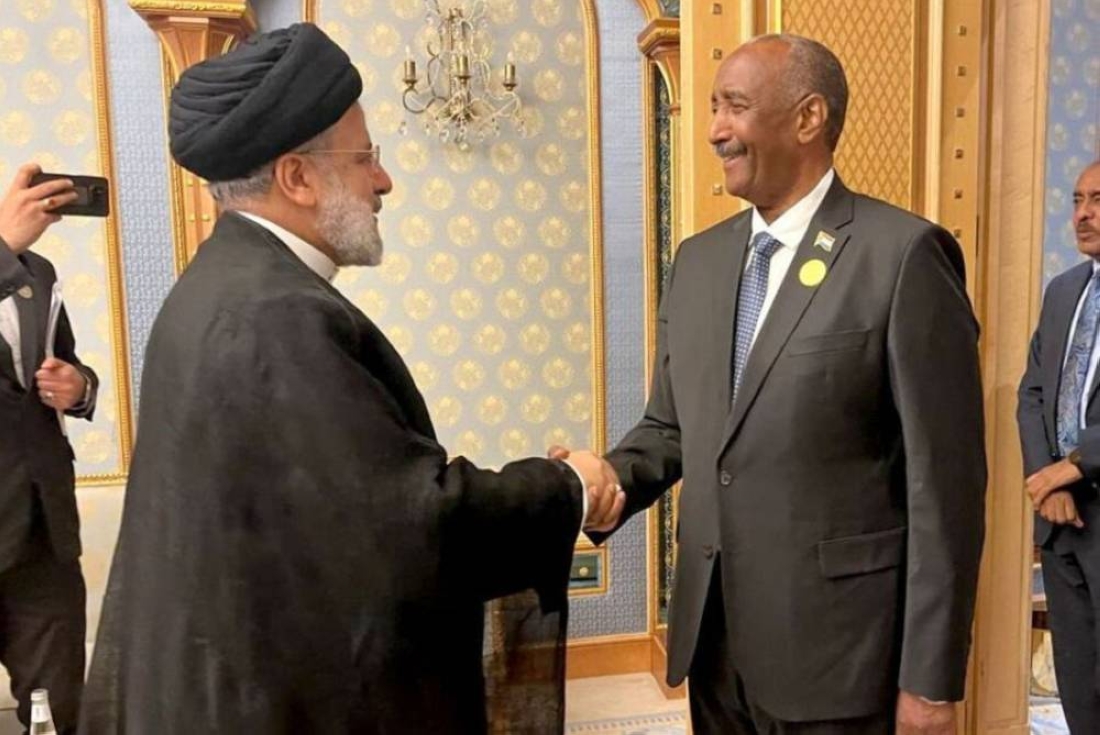
Despite Sunni–Shia differences, the Brotherhood’s relationship with Iran has been driven by strategic pragmatism. Sudan served as a transit point for Iranian weapons destined for Hamas, particularly between 2009 and 2012. Arms originating in Iran and post-Gaddafi Libya moved through Sudan toward Gaza, contributing to repeated Israeli strikes on Sudanese territory. For Iran, Sudan offered geographic reach into Africa. For the Brotherhood, Iranian support provided leverage, resources, and regional relevance. Ideology proved secondary to shared enemies and mutual utility.
Why Sudan Matters for Africa—and for Europe
Taken together, these patterns lead to an unavoidable conclusion: the Muslim Brotherhood is not an external influence on al-Burhan’s regime; it is its ideological and organizational backbone. The Brotherhood supplies fighters, intelligence expertise, political justification for prolonged war, and regional networks capable of mobilizing finance and propaganda. Al-Burhan’s leadership, in turn, provides legitimacy, arms, and access to the state—replicating the same bargain that sustained Islamist rule under Omar al-Bashir.
For Africa, the stakes could not be higher. A Sudan dominated by Brotherhood ideology and Iranian influence risks becoming a strategic hub for radical Islamist movements operating across the continent—from the Sahel to East Africa. Africa is rich in resources, young populations, and opportunity, but prolonged instability in Sudan would accelerate the spread of militancy, criminal economies, and proxy warfare. And if Africa pays the first price, Europe will not be spared. Migration pressures, security threats, and transnational networks do not respect borders. Sudan’s war may have many fronts, but its center of gravity remains the same. Until the Brotherhood’s grip on the state is broken, peace will remain elusive—and Africa’s promise will remain under threat.