









The MEDays 2025 Forum concluded with one certainty: the world is shifting, the Global South is asserting itself, and Morocco is emerging as one of the most influential voices in the new global order. From unanimous support for Resolution 2797 to calls for reforming the global financial system and demands for concrete South–South cooperation, the voices heard at MEDays outlined a demanding roadmap for the months ahead.
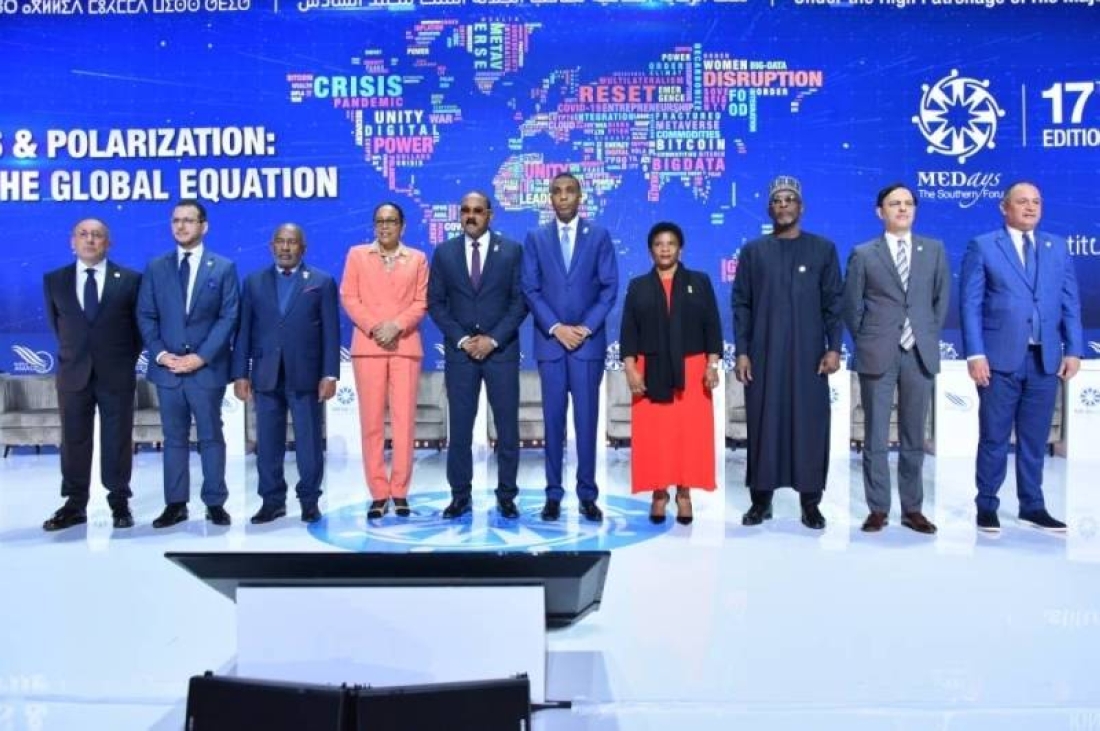
In Tangier, the closing ceremony of the 17th edition of the MEDays Forum brought together an unprecedented constellation of heads of state, prime ministers, and African and Caribbean leaders, all united by a shared conviction: the Global South is no longer a spectator — it is becoming an active player in the global equation.
From the outset of the final session, President Azali Assoumani of the Union of the Comoros set the tone: gratitude toward Morocco, praise for the vision of King Mohammed VI, but above all, a call to break away from the “fractures” weakening the world.
He commended “a forum that has become a true laboratory of strategic ideas” and welcomed the adoption of UN Security Council Resolution 2797, described as a historic turning point for regional stability.
The Caribbean offered the same unwavering support: Dominica’s President Sylvanie Burton reiterated her country’s “unshakeable support” for Morocco’s sovereignty over the Sahara, noting that Resolution 2797 “establishes autonomy as a durable and realistic basis.” She also praised Morocco as “a stable, visionary country, and a pillar of South–South cooperation.”
MEDays Becomes “a Summit”
Brahim Fassi Fihri, President of the Amadeus Institute, described this 17th edition as “exceptional”: 8,500 participants, 100 nationalities, 300 speakers, and 200 accredited media outlets.“This is no longer a forum — it is a summit,” he declared, emphasizing Morocco’s central role in transforming the continent and reshaping multilateralism.
He confirmed that Resolution 2797 was the major political anchor of this edition:“A new chapter is opening after fifty years of deadlock.”
Antigua and Barbuda’s Prime Minister Gaston Browne delivered one of the most striking speeches. While congratulating Morocco for its diplomatic achievement, he described an international system “fractured,” facing mounting geopolitical crises, debt, financial inequality, and climate disruption.He posed a highly meaningful question:“Will we allow instability to define humanity’s destiny, or will we fight for a new world order founded on unity and love?”
He also called for deep reform of the international financial system and a more equitable multilateralism.
For his part, Somalia’s Prime Minister stressed that Africa and the Global South are no longer mere petitioners but “providers of solutions.”According to him, MEDays demonstrates that “the South must believe in its own power” and “speak with one voice” to influence global decisions.“Unity is our original strength,” he emphasized.
Sovereignty and Modernization
State Minister Ilza Maria dos Santos Amado Vaz recalled the urgent need for Africa to assert its sovereignty — political, energy, digital, and food sovereignty — and to invest in education, innovation, and digital transformation. She praised Morocco’s vision as “an inspiring model for the continent.”
Minister of Economic Inclusion, Small Business, Employment and Skills Younes Sekkouri warned against the excesses of modern governance. He summed up what the Global South must avoid: blind punishment, symbolic gestures, and immobility.
Meanwhile, Minister of Industry and Trade Ryad Mezzour emphasized the importance of placing humans back at the center of public decision-making:“Data measures impacts, never lived experience.”He called on the Global South to face reality and build a leadership that is clear-eyed, rigorous, and ambitious.
One Forum, One Voice
Beyond the speeches, one central message dominated the closing ceremony: Morocco is now recognized as a pillar of stability and South–South cooperation.As Brahim Fassi Fihri put it:“The Global South is now taking its destiny into its own hands. It has lessons to receive from no one.”
The 17th edition of MEDays thus ends on a rare message: the conviction that the world can still reinvent its equations — and that the Global South is no longer waiting; it is acting.