








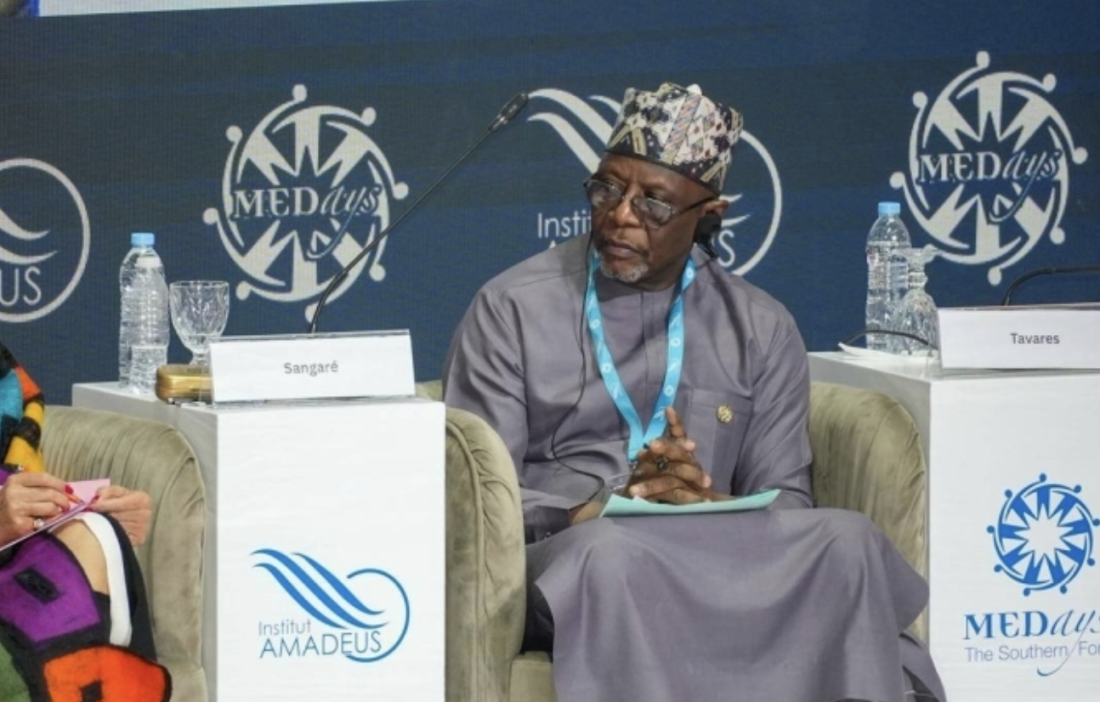


For Niger’s Minister of Foreign Affairs, Bakary Yaou Sangaré, the Royal Atlantic Initiative launched by King Mohammed VI represents far more than a strategic project—it is a geopolitical, economic, and logistical lifeline. In a context of regional pressure, forced isolation, and international injustice, Morocco was “the first country to open its doors” and offer a vital alternative to the Sahel countries.
In Tangier, during his first participation in the MEDays Forum, Niger’s Minister of Foreign Affairs, Bakary Yaou Sangaré, acknowledged that the Royal Atlantic Initiative led by King Mohammed VI marked a decisive turning point for Niger, a landlocked country long confronted with sanctions and political pressures.
In an imbalanced world marked by a global financial governance that is “unjust and chaotic” and by a paradoxical access to financing, the Nigerien official explained that the Sahel countries — Niger, Mali, Burkina Faso — had to unite to create the Confederation of Sahel States (CES). But while some regional blocs considered sanctioning them or even isolating them, one country chose openness: Morocco.
In an imbalanced world marked by a global financial governance that is “unjust and chaotic” and by a paradoxical access to financing, the Nigerien official explained that the Sahel countries — Niger, Mali, Burkina Faso — had to unite to create the Confederation of Sahel States (CES). But while some regional blocs considered sanctioning them or even isolating them, one country chose openness: Morocco.