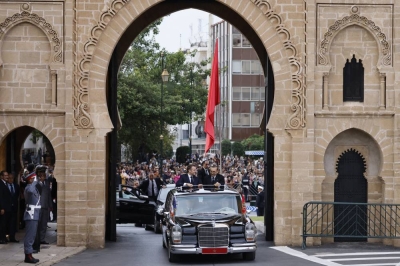









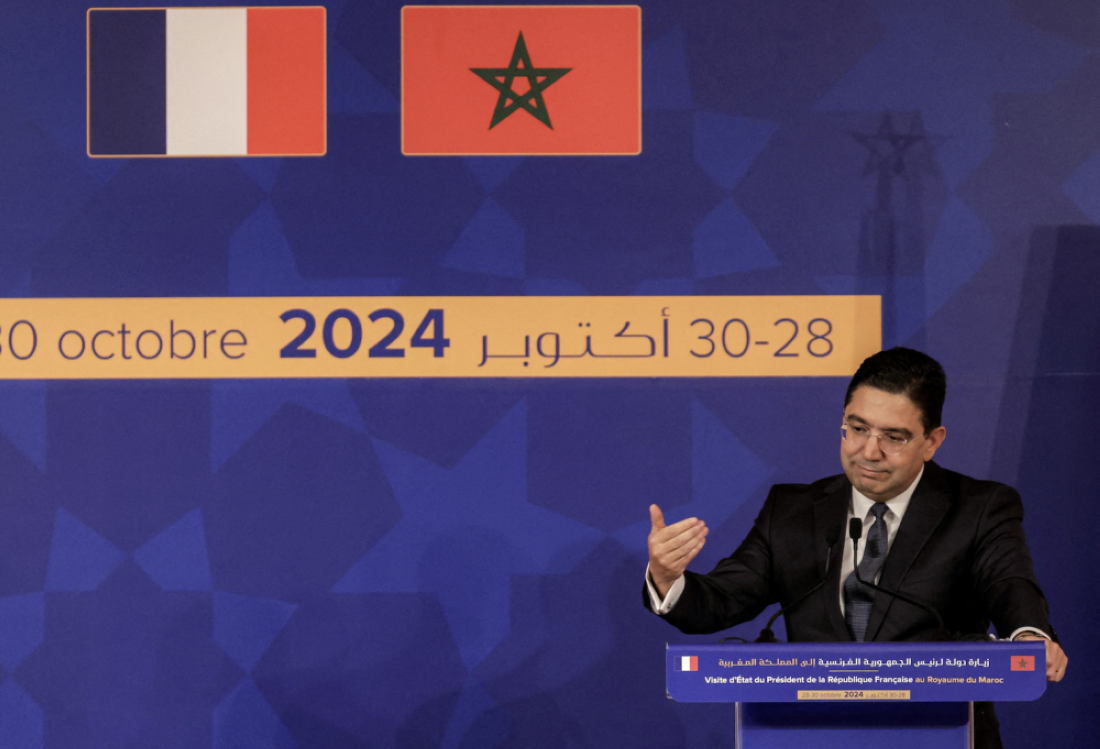


The State visit to Morocco by French President Emmanuel Macron marked the beginning of a new chapter in bilateral relations, emphasized Nasser Bourita, the Minister of Foreign Affairs, African Cooperation, and Moroccans Abroad, in an interview with Le Point magazine published on Saturday.
This visit, he noted, opens a formal chapter, solidified by the signing of a highly significant declaration on the Enhanced Exceptional Partnership by His Majesty King Mohammed VI and President Macron.
This document, the minister explained, "reflects a renewed ambition for bilateral cooperation, firmly rooted in principles of equality between states, transparency, solidarity, and shared responsibility."
This declaration, he added, "outlines the priority areas of collaboration—such as renewable energy and the modernization of railway and port infrastructure—which are poised to become the foundations of an enriched and mutually beneficial relationship."
The minister specified that "the governance of this partnership is also defined within the declaration: it will be directly supervised by the two heads of state and monitored by a select committee tasked with forging innovative pathways and seizing opportunities to anchor the strengthening of this relationship over time."
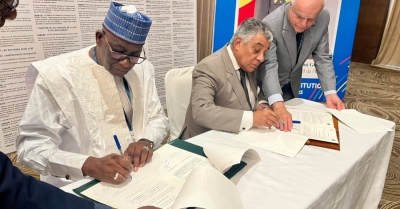
The agreements signed in the presence of the Sovereign and the French President inaugurate a new generation of commitments, revealing a shared vision, noted the minister, highlighting that "the partnership is based on an authentic collaborative approach, a genuine ‘doing with Morocco,’ which involves working together while recognizing and enhancing the potential of Moroccan enterprises."
In this context, Mr. Bourita pointed out that "flagship partnerships around High-Speed Rail and green hydrogen embody this new spirit."
Regarding France’s position on the Moroccan Sahara, the minister indicated that it aligns with a global dynamic initiated years ago by His Majesty King Mohammed VI, marked by numerous explicit acknowledgments of Moroccan sovereignty over the Sahara, through the opening of around thirty consulates in Laâyoune and Dakhla and growing support for the autonomy plan as a solution to this regional dispute.
Within the European Union, the minister recalled, nearly 20 out of the 27 member countries also support this approach, noting that France's position is significant because it comes from a permanent member of the United Nations Security Council and, above all, a country familiar with the realities of the region and a major player in the EU.
The minister asserted that "today, all the conditions are in place to move forward," noting that "the autonomy initiative enjoys support from over 112 countries worldwide, including more than twenty American nations, among them the United States, nearly three-quarters of African states, and several European Union members."
This international dynamic, he highlighted, extends to every continent and region, though he regretted that the real actor behind this regional dispute continues to prefer the status quo.
This stagnation, he lamented, impacts regional security and imposes a cost on the Maghreb, the Sahel, both shores of the Mediterranean, and especially on the Moroccan and Algerian people.
Addressing the regional geopolitical issues in light of Morocco’s initiatives, particularly the Atlantic Initiative launched by His Majesty the King toward Sahel countries, Mr. Bourita stated that "in His Afro-optimistic approach, His Majesty King Mohammed VI has always refused to see the Sahel as a foregone conclusion. That is why He has visited Mali four times since 2012, invested significantly in training over 500 imams at the Mohammed VI Institute for the Training of Imams, and initiated numerous development projects, in addition to Morocco’s presence in the banking and economic sectors."
It is in this spirit, the minister explained, "that the Royal initiative was launched, offering Sahel countries access to Moroccan ports, storage zones, logistics infrastructure, fiber optics, and customs procedures assistance. The idea is to open up the Sahel and lift it out of isolation."
The minister noted that responses to this Royal initiative have been very positive: three ministerial meetings have already taken place, and task forces have been set up by the concerned Heads of State to foster ownership of this initiative. A reference document has been produced and will soon be submitted to the Heads of State for approval, with projects to be launched in the short, medium, and long term."
He also pointed out that "France, which is also engaged in this region, pursues its goals with its own unique approach," adding that "the common objective remains the stabilization of the Sahel, with profound respect for the choices of its peoples and a firm commitment to fostering their development."