







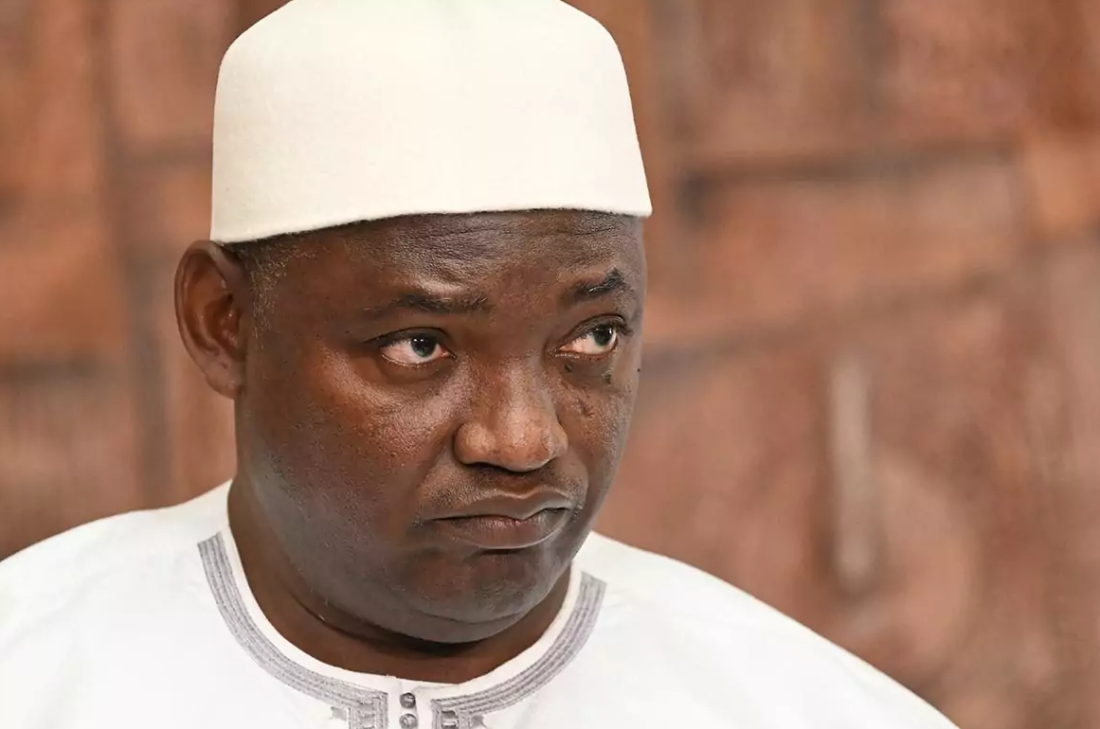


Gambian President Adama Barrow officially submitted his nomination papers to the Independent Electoral Commission (IEC) on Tuesday ahead of the presidential election scheduled for December 5.
The decision has reignited controversy over a third term, after the head of state previously pledged that his second term in office would be his last.
The 61-year-old leader arrived at the IEC headquarters accompanied by his two wives and was greeted by thousands of supporters of the National People’s Party (NPP), dressed in grey and gathered to show their support.
Adama Barrow rose to power in December 2016 after defeating Yahya Jammeh, who had ruled The Gambia for more than two decades. He was subsequently re-elected in 2021, defeating his former political ally Ousainu Darboe, the United Democratic Party (UDP) candidate.
Before IEC Chairman Joseph Colley, the president completed the formalities required to register his candidacy. The documents include proof of Gambian citizenship, a tax clearance certificate and an asset declaration. Candidates must also pay a deposit of one million dalasis and submit at least 5,000 supporting signatures.
Following the procedure, Joseph Colley informed the incumbent president that the various stakeholders in the election had signed a political peace pact.
Speaking to the press, Adama Barrow defended his record, saying that his ten years in office had preserved peace and delivered significant infrastructure improvements. He also pledged to continue his “Yiriwa” programme, meaning “growth” in Mandinka.
The programme includes improving access to electricity in remote communities and developing the agricultural sector. For the incumbent president, peace and stability remain essential foundations for national prosperity.
However, presidential term limits remain a central issue. While expressing support for the principle, Adama Barrow justified his renewed candidacy by citing appeals from his supporters, saying he could not ignore their desire to see his programme continue. He also cited Germany’s example to argue that effective governance does not necessarily depend on limiting the number of terms in office.
Nevertheless, the leader pledged to amend the Constitution to introduce presidential term limits if he wins the December 5 election. The promise comes as his decision to seek a third term renews debate over his earlier political commitments.
In defending his candidacy, Adama Barrow emphasises his experience as head of state and the continuity of his government’s work. He considers his record an advantage over opponents who, he argues, have less experience in government.
His main rival remains Ousainu Darboe, his former political mentor, who submitted his nomination papers to the IEC on Monday, accompanied by numerous supporters from the UDP and allied parties.
A total of 1.1 million Gambians are registered to vote in the election, which comes amid political debate over term limits and the future of governance in the country.