








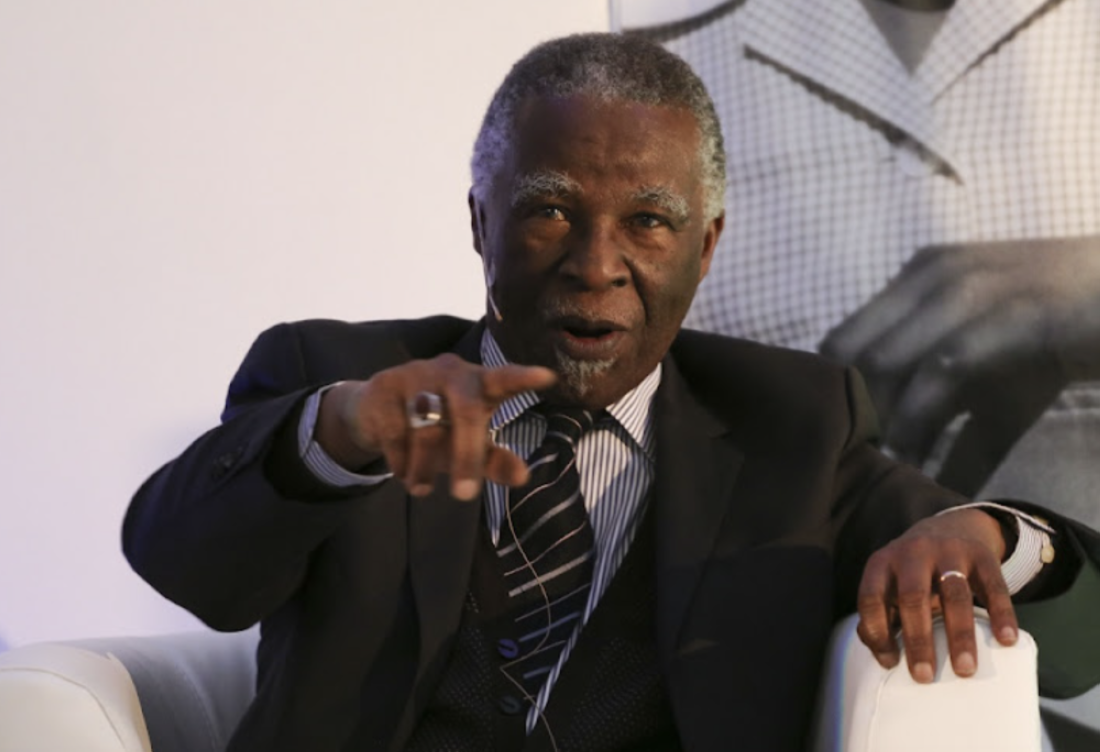


Former South African President Thabo Mbeki painted a grim picture of the country on Monday in Cape Town. South Africa is grappling with widespread corruption, a record unemployment rate (33%), rampant crime, and stark poverty and inequality.
Speaking at a two-day conference themed “The Challenges of the ANC and the National Democratic Revolution,” Mbeki stated that the social pact intended to address unemployment and poverty in the country had effectively been abandoned by the government.
President Cyril Ramaphosa recently admitted that the executive and its social partners had failed to deliver on their promise to establish a social pact. “We have not been able to conclude a social pact within the timeline we had anticipated because several new circumstances made it difficult for social partners to reach a consensus,” he said.
Mbeki also touched on the Government of National Unity formed after the May 29 elections, which pledged to organize a national dialogue allowing all sectors of society to voice their concerns. However, he expressed doubts about whether the African National Congress (ANC) still had the ability to influence these discussions. “Does the ANC still have the capacity to shape this debate?” he asked, pointing out that the dialogue would need to address numerous issues, including the economy, culture, health, and education.
Ahead of the May elections, the former President, then on the campaign trail, said he had suggested the ANC convene a national convention after the elections to examine the country’s challenges. “We needed to call a national convention to bring together the entire nation, political parties, civil society, trade unions, businesses, and religious groups so that together we could address all the problems that have arisen over the past thirty years since the end of apartheid,” he said, lamenting the government’s failure to improve the lives of South Africans.
Discussing the crisis within the ANC, Mbeki noted that Nelson Mandela’s party faces two major challenges: “its renewal and the use of state power to do what is right.” “If the African National Congress wants to survive, it must change its actions and reconnect with the people,” he suggested. In the latest elections, the ANC lost its absolute majority in Parliament for the first time in 30 years, securing only 40% of the vote. Weakened by this result, the ANC was forced to form alliances with nine other political parties to establish a coalition government.