







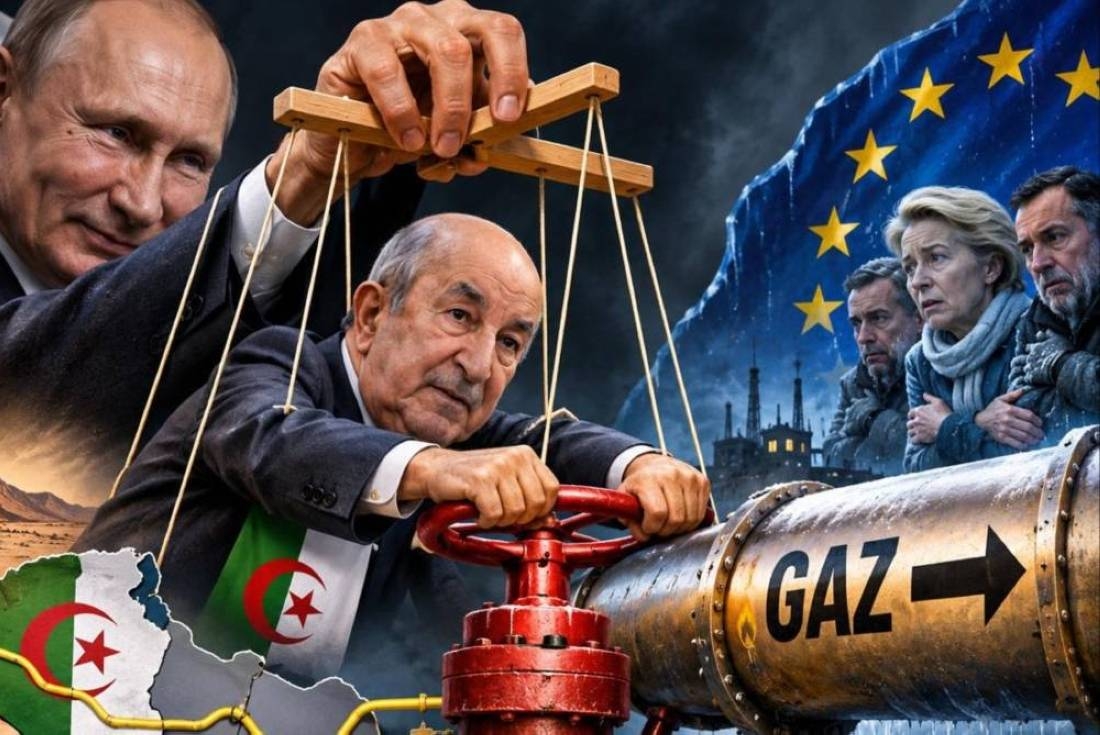


“We will protect Niger no matter what,” Algerian President Abdelmadjid Tebboune declared, justifying the deployment of his troops to this Sahel country. The European Union is closely monitoring the situation, as explained on October 30, 2026, by the EU spokesperson for foreign affairs. An initial reading of the intervention suggests that Europe may have understood what was happening.
On November 1, the Russian and Algerian foreign ministers discussed Moscow’s participation in the Nigeria-Niger-Algeria gas pipeline project, according to Algerian media. This is no insignificant development.
Russia, whose gas deliveries to Europe are set to be eliminated in 2027, would like to gain control over supplies from Nigeria. This would be a way to circumvent the European decision. Algeria would serve as its regional executor. The Nigeria-Morocco gas pipeline appears to be the most credible and sustainable project.
On January 26, 2026, the European Union adopted a regulation establishing the gradual phaseout of Russian gas imports, with a general deadline in 2027.
The process was already underway. In 2021, Russian gas accounted for 45% of total imports. By 2025, this share had fallen to 12%.
This development deprives Russia of an important geostrategic lever. It can no longer exert pressure on Europe through gas.
Europe’s determination to diversify its energy supplies is of great interest to several West African countries. Nigeria could supply 30 billion cubic meters annually, provided the necessary infrastructure is available.
This is where all attention is focused. In terms of infrastructure, there are actually two projects: the Atlantic gas pipeline, running from Nigeria to Morocco through 12 other African countries that could also benefit from gas supplies, and the Nigeria-Niger-Algeria gas pipeline.
The Nigeria-Morocco route is relatively advanced. It reached an important diplomatic milestone in July 2026 with the signing of an intergovernmental agreement supported by ECOWAS. Its feasibility and preliminary engineering studies have been completed, but financing and supply contracts are still being finalized. An advantage highlighted by Petroleum Economist is that this route avoids the insurgency-affected areas of the central Sahel.
Moreover, the Atlantic gas pipeline project is not intended solely to supply Europe. Of the 30 billion cubic meters planned for this corridor, half would be destined for African markets and the other half for Moroccan and European markets.
By contrast, the Nigeria-Algeria route presents a major security challenge and appears to focus exclusively on the European market. Northern Nigeria, Niger, and even southern Algeria are unstable and face security disturbances linked to Islamist terrorist groups. Ensuring the security of the pipeline and the workers responsible for its construction and maintenance would be difficult.
This explains why the Algerian regime is attempting to deploy its troops in Niger. As it explicitly states, this deployment is intended to protect Algeria’s economic interests, particularly the facilities of its oil company, in the short term. It could also use these forces to secure the gas pipeline.
This is where Algerian and Russian interests converge. If the Nigeria-Algeria route is ultimately selected, Russia would gain a means of exerting pressure on the final gas customer. Since Russia already has forces in the region, it could present itself as the main power fighting armed groups and ensuring the secure flow of gas.
In other words, the Kremlin would have its hand on the gas valve. Algeria, after all, does not have the capacity to ensure security in the region on its own. Moreover, the equipment used in Niger is entirely Russian.
Russia would thus have responded favorably to the Algerian president, who asked President Vladimir Putin on June 15, 2023, to help Algeria safeguard its sovereignty. “The consolidation of Algerian independence was achieved with strong Russian assistance, through our armaments and the defense of our freedom under very difficult regional circumstances,” he said.
But, of course, this assistance would not come free of charge. Russia has interests that extend beyond the Algerians’ limited vision, primarily focused on Morocco’s growing power.
It is important for Europe to carefully assess its options.
Energy supplies must take into account the reliability of suppliers and delivery routes. Yet Russia and Algeria have already demonstrated that they do not hesitate to politicize this trade.
And they intend to gain control over Europe’s energy supplies. Such a prospect would undoubtedly be unwelcome to the European Union, which has already experienced supply difficulties. This is a strategic issue.
On November 1, 2026, Algerian Foreign Minister Ahmed Attaf discussed the participation of Russian companies in the Trans-Saharan gas pipeline with his Russian counterpart, Sergey Lavrov.
According to his statements to an Algerian media outlet, a contract is reportedly being finalized. The companies involved have not been officially identified, but Russian pipe manufacturer TMK has already been mentioned as a potential participant.
This provides a clearer understanding of the deployment of Algerian soldiers to Niger: to demonstrate that Nigerian gas will reach European customers safely. But at what cost?
Now the serious work begins. The Nigeria-Niger-Algeria gas pipeline would stretch 4,000 kilometers, with a planned investment of $15 billion. On the Atlantic side, the 6,900-kilometer Nigeria-Morocco gas pipeline would cost $25 billion. However, since the Nigeria-Niger-Algeria pipeline would require military forces to secure it, its total cost over 30 years would change considerably. It could reach $53.5 billion (an estimate made using AI).
The Atlantic project would also require security measures, but within the normal requirements of a project of this scale.