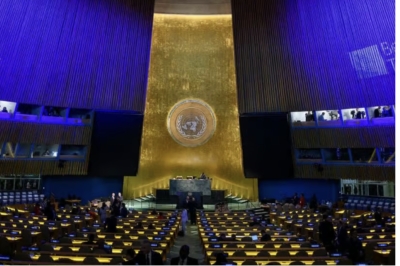







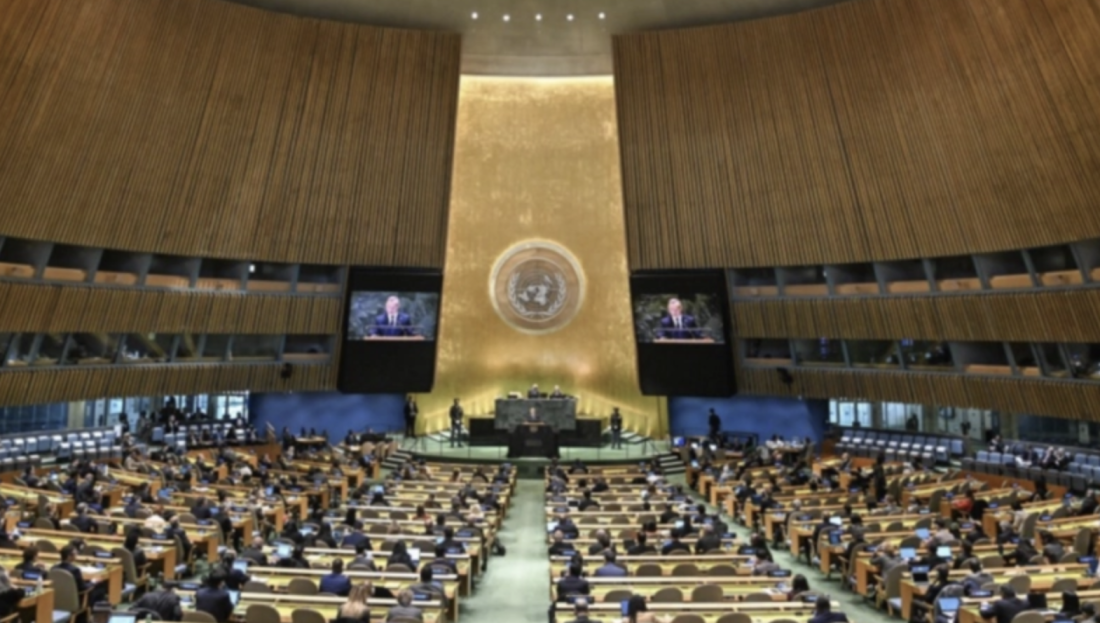


International support for Morocco’s autonomy plan was once again firmly demonstrated on Tuesday, November 10, before the United Nations General Assembly. From the United States and Europe to Africa, the Gulf and Latin America, numerous delegations reaffirmed their endorsement of the initiative as the only basis for a definitive political settlement of the artificial dispute over the Moroccan Sahara.
The message from New York is unequivocal. An overwhelming majority of UN member states are declaring more forcefully than ever that Morocco’s autonomy plan constitutes the only serious, credible and realistic basis for definitively resolving the Moroccan Sahara issue. Successive statements delivered on Tuesday, November 10, before the United Nations General Assembly confirmed the strength of the diplomatic momentum driven by HM King Mohammed VI.
The plenary session was devoted exclusively to Russia’s veto, on October 30, of a US-drafted resolution that had secured eleven of the fifteen votes in the Security Council. The text notably called for a twelve-month extension of MINURSO’s mandate and established Morocco’s autonomy initiative as the basis for negotiations.
The first strong signal came from the United States. Its ambassador to the United Nations, Mike Waltz, expressed regret that Russia had exercised its veto just as the political process had gained renewed momentum following the adoption of Resolution 2797 in 2025.
“The historic Resolution 2797 established Morocco’s Autonomy Initiative as the basis for advancing negotiations,” he recalled.
Washington, however, has no intention of abandoning its efforts. “The United States has not given up on finding a solution and playing a leading role in bringing this conflict to a constructive conclusion,” Waltz affirmed. US diplomacy therefore intends to remain actively engaged alongside the parties and the United Nations to advance a definitive settlement of the Moroccan Sahara issue.
The ambassador also recalled the three rounds of high-level talks held this year in Madrid and Washington, notably with the participation of Algeria and Mauritania. He welcomed Morocco’s commitment to maintaining the ceasefire and called on the Polisario Front to adopt the same approach.
France reaffirmed an equally clear position. According to its ambassador to the UN, Jérôme Bonnafont, the “present and future” of the Sahara lie within the framework of Moroccan sovereignty. Paris considers the autonomy plan the path toward a just, lasting and mutually acceptable political solution. The French diplomat described Resolution 2797 as a “decisive turning point” that had paved the way for the resumption of direct negotiations.
The United Kingdom maintained the same consistent stance. London continues to regard Morocco’s 2007 initiative as “the most credible, viable and pragmatic basis” for achieving a lasting settlement. Portugal, for its part, defended what it described as “the most serious, credible and constructive option,” calling for the ongoing political momentum to be pursued without delay.
The European Union delegation also reiterated its support for the UN-led political process. Its ambassador, Stavros Lambrinidis, speaking on behalf of EU member states and other candidate countries, endorsed the continuation of negotiations based on Morocco’s autonomy proposal.
Support from the Gulf remains equally firm. Speaking on behalf of the member states of the Gulf Cooperation Council, Bahrain’s ambassador, Jamal Fares Alrowaiei, reaffirmed the organization’s longstanding position in support of Morocco’s sovereignty over the Sahara and its autonomy initiative.
Speaking subsequently in his national capacity, the Bahraini diplomat renewed his country’s support for the Kingdom’s sovereignty and territorial integrity, while commending Morocco’s commitment to an orderly withdrawal of MINURSO.
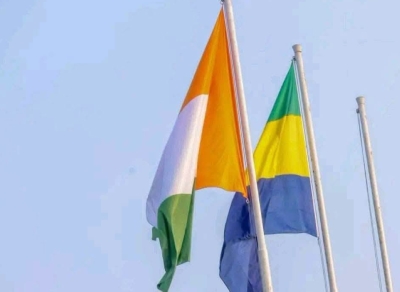
Africa also made its voice heard through a series of converging positions. Côte d’Ivoire, Sierra Leone, The Gambia, the Comoros, Madagascar, Guinea-Bissau and Equatorial Guinea reaffirmed their support for autonomy under Moroccan sovereignty.
Côte d’Ivoire’s representative, Alley Christine Yapi Nee Bah, recalled that the initiative enjoys the support of approximately 130 countries, including three permanent members of the Security Council. She praised the economic and social development efforts undertaken in Morocco’s southern provinces, as well as initiatives to promote human rights, particularly through the regional commissions in Laâyoune and Dakhla.
The Gambia strongly defended the same position, describing Morocco’s plan as the “only realistic, credible and sustainable basis for negotiations.” The Comoros, meanwhile, called on the four parties to resume constructive dialogue, while Guinea-Bissau advocated a definitive settlement exclusively within the framework of autonomy under Moroccan sovereignty.
Latin America was equally represented in this diplomatic mobilization. Ecuador presented autonomy as the most realistic option for breaking the deadlock. Guatemala, through its ambassador José Alberto Briz Guterres, stressed the importance of preserving the diplomatic gains achieved in recent years, arguing that the difficulties encountered in the Security Council should not undermine this momentum.
Beyond their political support, several delegations commended Morocco’s commitment to maintaining the ceasefire and fully cooperating with the United Nations to ensure the orderly, safe and dignified withdrawal of MINURSO personnel.
The significance of this session therefore extends well beyond a routine diplomatic exercise. Although Russia’s veto prevented the adoption of a new Security Council resolution, it has in no way called into question the political gains secured through Resolution 2797 or the growing international convergence around Morocco’s autonomy plan.
The debate is set to continue on Wednesday, November 11, with statements expected from 31 additional delegations. This next stage will provide a broader measure of the extent of international support for the autonomy plan under Moroccan sovereignty.