







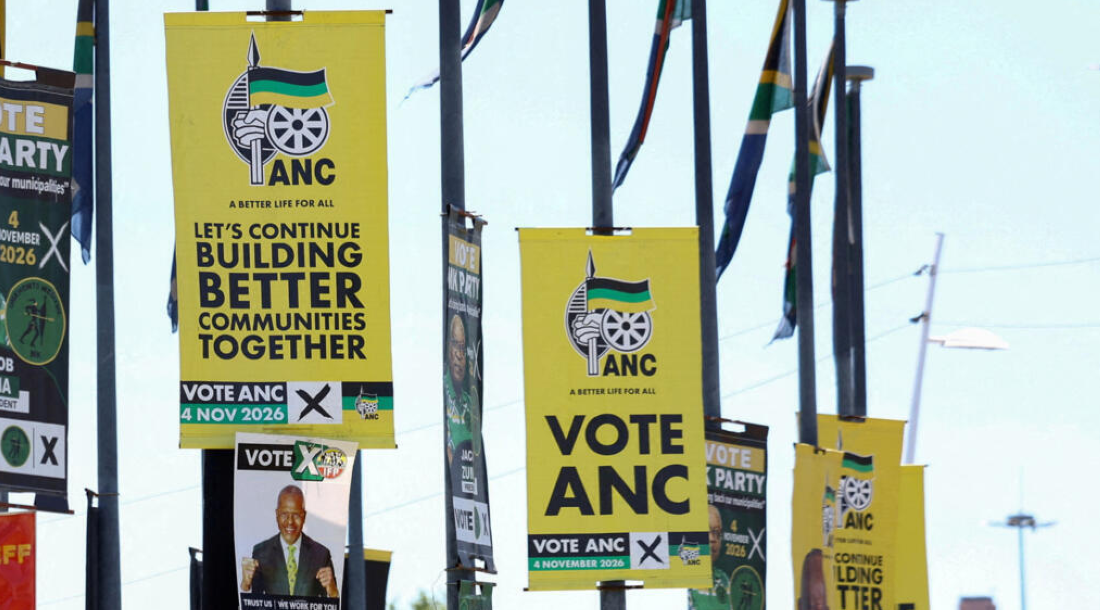


Official results announced on November 8 confirm a historic setback for the African National Congress (ANC), President Cyril Ramaphosa’s party. The ANC remains the country’s largest political party, but secured only around 31% of the vote, compared with nearly 46% in the 2021 municipal elections. Its changing fortunes have implications that extend beyond South Africa’s borders.
In several African countries, parties born out of liberation or independence struggles have long drawn their political legitimacy from their historical role.
Thirty-two years after the end of apartheid, the ruling African National Congress (ANC) is facing a historic political crisis. With just 31% of the vote in the municipal elections held on November 4, 2026, the party of Nelson Mandela and President Cyril Ramaphosa has recorded its worst-ever electoral result. Behind this defeat lies a profound transformation of South African democracy: the prestige of national liberation is no longer enough to guarantee voter loyalty.
Historical Loyalty Wanes
In 1994, when Nelson Mandela became South Africa’s president, the ANC represented far more than a political party. It embodied victory over apartheid, the achievement of democracy and the promise of a society free from racial segregation.
For decades, this historical legitimacy ensured its extraordinary dominance over South African political life.
But thirty-two years later, the landscape has changed profoundly.
In the municipal elections of November 4, 2026, the ANC secured only around 31% of the vote, compared with nearly 46% five years earlier. It remains the country’s leading political force, but has lost a large share of its traditional electorate.
This setback is no isolated event. It extends a decline already evident in previous elections and particularly striking in the 2024 parliamentary vote, when the ANC lost its outright majority in Parliament for the first time.
The question, therefore, is no longer simply why the ANC is losing elections, but why the party that embodied national liberation can no longer sustain the trust of a majority of South Africans.
A Time of Reckoning
The ANC long benefited from considerable political capital rooted in its struggle against apartheid.
But that capital has gradually been eroded by everyday realities.
For a new generation of voters born after 1994, the struggle against segregation belongs to history. Their immediate concerns are now jobs, housing, safety, access to water and electricity, the quality of schools and the functioning of public services.
These are precisely the areas in which successive governments and many municipalities have faced mounting difficulties.
South Africa remains marked by deep social and economic inequalities. Unemployment, particularly high among young people, fuels frustration. In several cities, residents face water supply interruptions, deteriorating infrastructure and inadequate waste collection.
These problems are not all solely the ANC’s responsibility. They also stem from structural inequalities inherited from apartheid, financial constraints and institutional difficulties. But after more than three decades in power, the party can no longer present itself solely as the heir to a historic struggle: it is also being judged on its record.
Corruption: A Deep-Rooted Problem
Compounding these economic and social difficulties is a succession of corruption scandals that have severely damaged the ANC’s image.
Cyril Ramaphosa’s rise to the presidency in 2018 raised expectations of reform and greater integrity in public life.
But governance problems, internal rivalries and allegations of mismanagement have continued to weigh on the party’s reputation.
Against this backdrop, municipal elections have become a means of punishing not only local officials, but also the political organisation that endorsed them.
The Opposition Gains Ground but Remains Fragmented
The ANC’s defeat does not mean that another party now commands a national majority.
The Democratic Alliance (DA), the country’s second-largest party, secured around 25% of the vote. It advocates an economic approach favourable to the private sector and highlights the quality of its municipal governance.
The uMkhonto weSizwe (MK) party, associated with former president Jacob Zuma, won nearly 10% of the vote, confirming the presence of a rival rooted in the ANC’s former political sphere.
The Economic Freedom Fighters (EFF), which advocate radical economic redistribution, also retain significant representation.
Alongside these parties are several local and regional formations whose influence could prove decisive in building municipal majorities.
South African politics is thus entering a phase of fragmentation. The central question is no longer simply which party finishes first, but which alliances can govern.
A Rebuke from the Major Cities
The ANC’s decline is most pronounced in the major urban centres.
In Johannesburg, the country’s economic capital, water supply problems, deteriorating roads and failures in waste collection featured prominently in the election campaign.
The results show a substantial weakening of the ANC against the Democratic Alliance and other parties.
But the fragmented vote also complicates matters for its opponents.
In many municipalities, no single party holds an outright majority. Negotiations between political parties will therefore determine the composition of local administrations.
This could lead to complex coalitions, sometimes involving partners that oppose one another at the national level.
Cyril Ramaphosa Faces the Crisis
For President Cyril Ramaphosa, the vote represents a second major political warning following the ANC’s loss of its parliamentary majority in 2024. The party was then forced to join a national coalition government. The 2026 municipal elections confirm that its electoral difficulties extend beyond a single contest.
The question now is whether the ANC can undertake sufficiently profound changes to restore voters’ trust.
The challenge goes beyond political messaging or replacing a handful of leaders. It concerns the party’s ability to improve public services, strengthen discipline within its structures and deliver visible results.
It also concerns its identity: how can a national liberation movement become a conventional governing party, subject to the same demands for accountability and the same prospect of losing power as its competitors?